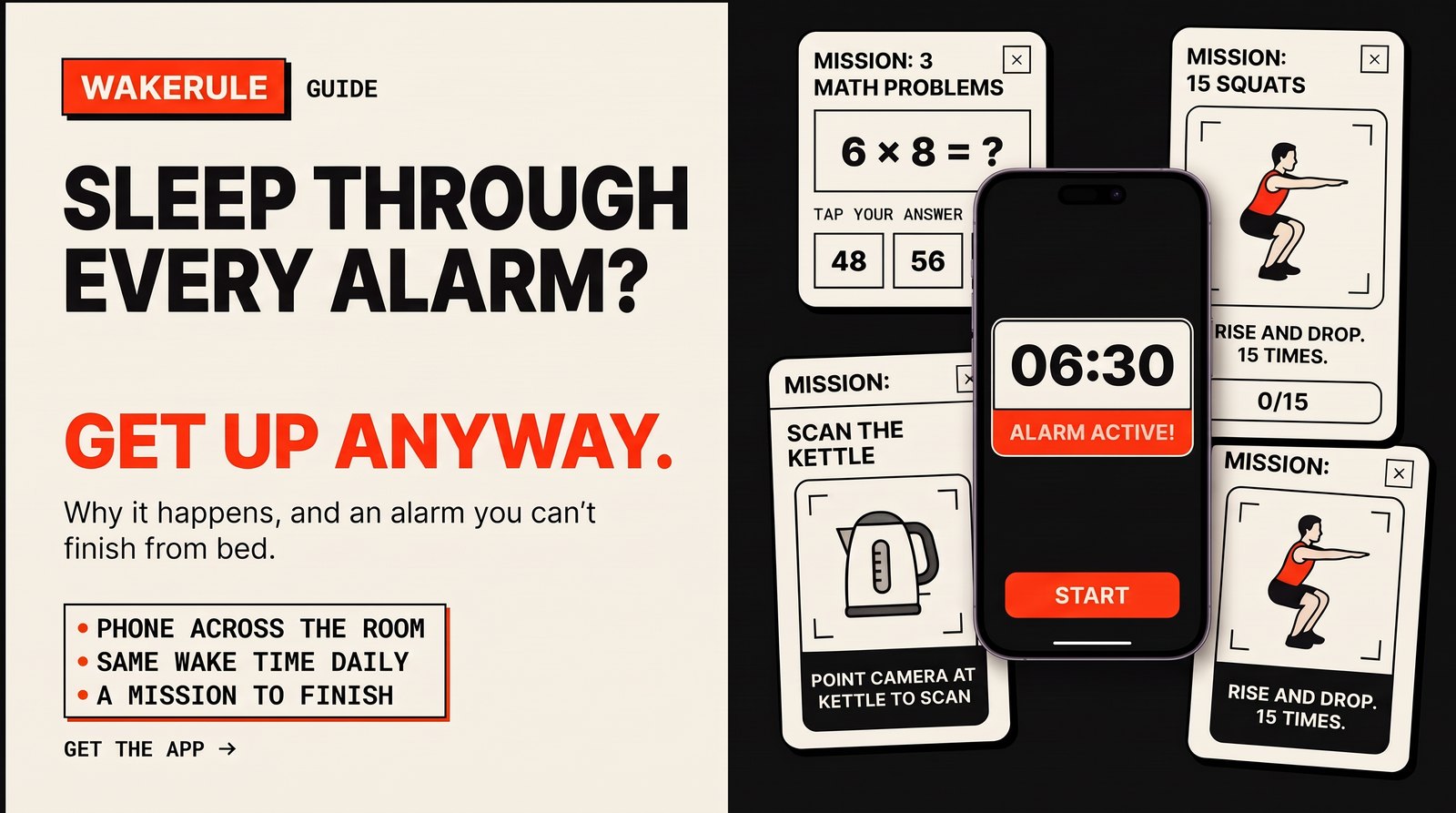
You set three alarms. You slept through all of them, or you switched them off and have no memory of doing it. If you are searching for how to wake up when you sleep through alarms, you are probably not lazy. Your alarm is losing a fight it was never set up to win.
Here is why that happens, and what actually helps. Most of it costs nothing.
Why you sleep through alarms
Usually a few things are going on at once.
Sleep inertia. Waking up takes a while. For the first stretch after you open your eyes, your brain runs slow: foggy thinking, poor judgement, a strong pull back to sleep. It is worst when the alarm catches you in deep sleep. This is the state in which you hit snooze with total confidence and zero memory.
Too little sleep. Most adults need seven hours or more. If you are getting five, your body is running a debt, and it collects first thing in the morning. No ringtone wins that argument for long.
Alarm habituation. Your brain is very good at ignoring sounds that turn out to be harmless. Play the same tone every morning for a year and it gets filed next to the fridge hum. Some people stop hearing their alarm. Others hear it and sleep straight through what it means.
The snooze habit. Snooze teaches you that the first alarm doesn't count. The extra minutes are broken, light sleep, so you don't get much rest out of them. Worse, you train your hand to reach for the button before you are awake enough to decide anything.
The phone by the bed. If the off button is within arm's reach, half-asleep you will find it. Half-asleep you is not on your side.
Something medical. If you sleep a full night and still can't wake up, feel wiped out all day, or someone tells you that you snore loudly or stop breathing in your sleep, see a doctor. Sleep disorders are common and treatable, and no app fixes them.
How to wake up when you sleep through alarms: the fixes
None of these are clever. They work because they take the decision away from the groggiest version of you.
Put the phone across the room. The oldest trick, and still one of the best. Charge it somewhere you have to stand up and walk to: the hallway, the bathroom, the kitchen counter. Standing up does half the job. The weak spot is that you can walk over, switch it off and walk straight back to bed, which is why the fixes below stack on top.
Wake up at the same time every day. Weekends too, within reason. Your body clock learns the time and starts waking you before the alarm goes off, so the alarm catches you in lighter sleep. Sleeping until noon on Saturday is a small jet lag you give yourself every week.
Get light, fast. Light is the strongest signal your body clock gets. Open the curtains, turn on the big light, step outside for a few minutes if you can. Leaving the curtains open a crack lets daylight start the job before the alarm does.
Sleep more. Boring, and the fix that makes every other fix easier. Count back seven or eight hours from your wake time and make that your bedtime.
Change the sound. If you have stopped hearing your alarm, swap it for something you haven't tuned out. A sound that starts quiet and gets louder is better than one that blasts at full volume and gets slapped off in a panic.
Drop the snooze button. Set one alarm for the time you actually need to get up. Ten alarms five minutes apart is snooze with extra steps.
Give your brain or body a job. This is the one that gets you past sleep inertia. A few math problems, a walk to another room, twenty jumping jacks. You can't do any of them asleep, and by the time you finish, your heart rate is up, you are warmer, and the bed looks a lot less convincing.
The catch is that every one of these relies on willpower at the exact moment you have the least of it.
Make the alarm do the hard part
That is why we built WakeRule, an Android alarm that keeps ringing until you complete a mission. You choose the missions at night, when you are thinking clearly. In the morning, the alarm holds you to them.
The free missions run on your phone and cost no credits:
- For your brain: Math, Typing, and Colour tiles, where you watch a pattern and repeat it.
- To get you across the room: Scan a code (a barcode or QR you registered, say on the coffee machine, so you have to walk to it), Photo (match a spot you photographed at setup), Item hunt (find a cup or your toothbrush and show it to the camera) and Steps.
- For your body: Shake, Shout, and six exercises counted by the camera on your phone: Out of bed, Jumping jacks, Squats, Push-ups, Touch your toes and Stand on one leg.
You can chain up to five missions on one alarm, and it stops only after the last one. Scan the code on the kettle, do 15 squats, then three math problems. By then you are standing in the kitchen with a working brain. Here is how exercise missions and chaining work.
The volume ramps up instead of blasting from the first second. If you start a mission and stop halfway, the ring comes back.
If the list doesn't cover your morning, the paid option lets you type any mission in your own words, like "drink a full glass of water", and AI watches through the camera to check it. That runs on credits: 1 credit is 1 minute, you get 3 free at sign-up, and packs are bought once, with no subscription. Frames are analysed, never stored. There are also no ads, ever, including on the ringing screen.
Want to compare options first? Here is our roundup of the best alarm apps for heavy sleepers.
A morning setup that works
Put it together and it looks something like this:
- A bedtime that gives you seven hours or more.
- The phone charging across the room, not on the nightstand.
- Curtains open a crack.
- One alarm, at the same time every day, no snooze.
- A mission that gets you walking, then one that gets you moving.
- The big light on as soon as you are up.
You don't need all of it on day one. Start with the phone across the room and a mission you can't do from bed, and add the rest as it sticks.
Common questions
Why do I sleep through my alarm?
Usually a mix of too little sleep, an alarm sound your brain has learned to ignore, and an off button you can reach without waking up. If you sleep a full night and still can't wake, talk to a doctor.
Is it bad to hit snooze?
For most people it doesn't help. The extra minutes are light, broken sleep, and the habit teaches you to ignore the first alarm. One alarm at the real time works better.
What is the best alarm for heavy sleepers?
One you can't turn off from bed. That means a phone across the room, or an alarm app that makes you complete a task first, like walking to a code, finding an object or doing a few squats. We compared several in our heavy sleeper roundup.
Can you train yourself to wake up without an alarm?
Many people find that with enough sleep and the same wake time every day, they start waking just before the alarm. Keep the alarm anyway, as a backup.